
Table of Contents

Introduction
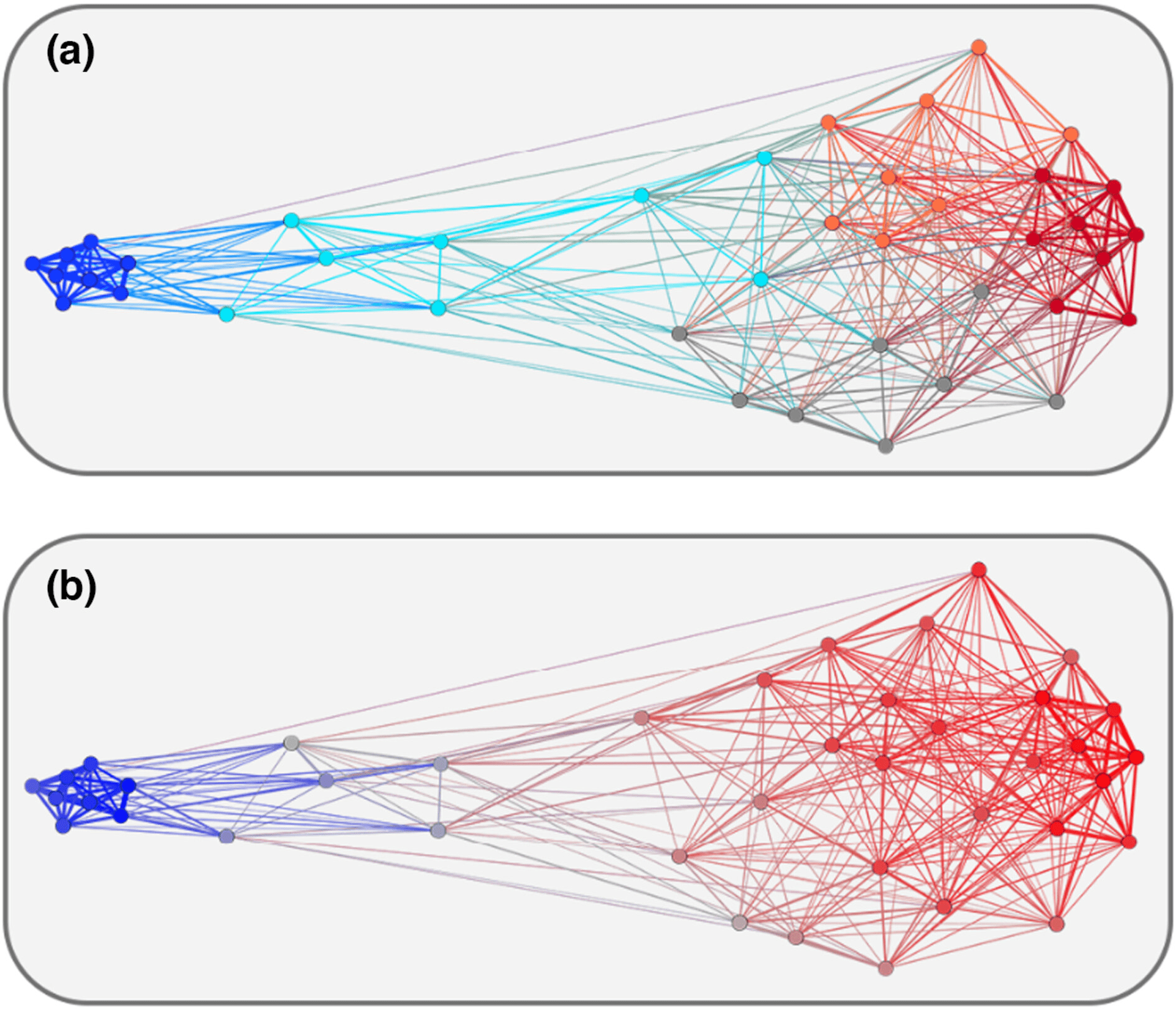
I have seen the following infographic taken from a study thrown around over the last several months, with conservatives posting it mostly:

Although they pride themselves on open-mindedness, liberal thinking actually coalesces around a very narrow set of opinion, whereas the Right diverges widely.
While true to some extent, this is not the flex that they think it is and I will try to cover why that is true in this post. I will go over the actual study and try to explain it so we can understand why the framing here is naturally deceptive.
I. The Study in Question
A. Personal Caveat
I am definitely not an academic in this field, so take what I say here with a grain of salt and recognize the limitations of my analysis. Below I will write my interpretation of what was done in the study.
B. Study Background Info
Here is the study in question if you want to take the time to read through it. It is actually not that long of a read (22 page-down pages) since it is not meant as an actual study of significance as you will understand once you read through it:
Here are 2 quotes about participants and participation in the study from their study page:
Participants were eligible if they were (a) at least 18 years old, (b) US residents, (c) native English speakers, (d) in support of US Democrats, Republicans, or Independents, and (e) received at least 98% approval from previous surveys. We excluded six participants who did not pass an attention check at the beginning of the survey, leading to an effective sample size of N = 396. The gender distribution was 50.5% males, 48.7% females, and 0.8% non-binary persons. Most participants were White Americans (83.6%), followed by African Americans (7.8%), leaving 8.6% to other ethnicities. The mean age was 34 years (SD = 11.7; Range = 18–81). On a categorical scale, 58.1% self-identified as Democrats, 28% as Independents, and 13.9% as Republicans.
Participants were invited to take part in an online survey with a mean completion time of 8 min and 20 s. After providing informed consent, participants responded to a set of items that assessed political viewpoints and indicated their partisan identification.
From what I read, I think this study is not done as a serious study meant to make waves or prove a point, or to be scientifically significant. I think this point is heavily reinforced by the potential issues with it: the lack of sample size; lack of demographics control like socioeconomics; lack of breadth of control via question selection, bias, and range; lack of equal ideological representation (13.9% Republican). I think they were looking to use this new technique and just publish their findings on its use to raise attention to it, which I think is supported a little bit from the 2 following quotes below:
We apply a newly developed attitude network-modelling technique (Response-Item Network, or ResIN) to study attitude–identity relationships in the context of hot–button issues that polarize the current US-American electorate.
The aim of this manuscript was to introduce ResIN as a network-modelling approach that may help research to further explore the dynamic interplay between attitudes and identities and their functional expressions in intergroup contexts.
I mean ya gotta publish or you are not relevant, right? So, take anything you could possibly read from this paper with a massive block of salt. I am not saying that you should completely ignore this study. Definitely not. There are some potentially interesting though not statistically significant concepts here which I find interesting, and they do give an interesting analysis. Although, it would be interesting to see this further expanded and tested and controlled. Like any scientific study, understand its limitations, and use it responsibly. =)
Anyone who is more educated on this sort of thing, please let me know if I need correcting on any of this. =)
C. The Questions
The study consists of a survey which asks questions on 8 politically controversial topics and then asks the participant how they feel on this topic using the standard 1 through 5 Likert Scale.
I found this list in this Reddit post which I think was extrapolated from the study itself:
- Abortion should be illegal.
- The government should take steps to make incomes more equal.
- All unauthorized immigrants should be sent back to their home country.
- The federal budget for welfare programs should be increased.
- Lesbian, gay and trans couples should be allowed to legally marry.
- The government should regulate business to protect the environment.
- The federal government should make it more difficult to buy a gun.
- The federal government should make a concerted effort to improve social and economic conditions for African Americans.
I am not sure how they picked their topics or questions or their wordings, but I have some significant feelings about the bias and quality of the questions. Question 1 is highly controversial and polarizing and is written in the positive for conservatism. Question 3 is moderately controversial and is written in the positive for conservatism. The rest of the questions are written middling in the positive for liberalism. I have lots of other thoughts and feelings about the questions and the sampling too, as I am sure that some of the rest of you do too, so I will leave it there for now.
D. The Visualization
Each question’s extreme answers (1 and 5) were determined to align with either Democratic (Liberal, blue) on the left side or Republican (Conservative, red) political ideals to the right. The visualized data shows each answer from each question out of context from the question, but listed in a way showing extremity of views and political alignment. The far left side (blue) shows answers that coincide with liberal ideology with an extreme 1 or 5 answer, and the far right side shows extreme answers (1 or 5) that coincide with Conservative (red) ideology. One point of the plot is Question 1 – Extremely Agree. Another point is Question 1 – Extremely Disagree, and so on. This was then plotted as you see in the graphic below:
E. Their Conclusion
Their conclusion from the bottom of the second-to-last paragraph:
… The advantage of this gain in flexibility is that we can explore the degree of “tolerance” for different attitude positions in different groups. According to the present findings, Democrats (more than Republicans) tightly centre their belief-system around a set of positions at the extremes of these particular items, implying that people who deviate from these positions are likely to be considered as outgroup members (extremity should thereby be understood as a function of both, the formulation of the item and the response). It is possible that holding extreme (and thus unnegotiable) attitudes on important social-political issues has become increasingly identity defining for Democrats, not least in response to Donald Trump’s controversial presidency. The pattern does not imply that Republicans are more tolerant than Democrats, nor that Republicans could deal better with attitudinal uncertainty. It does imply, however, that –at this particular moment in time– Democrats and Republicans are constructing and managing their partisan identities differently in relation to the topics reflected in these questionnaire items. Research suggests that social category membership (e.g., being White, Christian) is more important for the construction of Republican identity than it is for Democrat identity (Mason & Wronski, 2018). Fulfilling such normative criteria may hence qualify someone as a valid group member even if that same person may hold somewhat liberal views on, for example, gay marriage.
II. Conservatism

Sadly, this infographic is not the flex that Conservatives think it is. =)
A. Conservatism is Founded in Ignorance, Separation, and Entropy
Conservativism is founded in what I call “Humanity’s Terminal Disease – The Disease of Separation” which is the abject rejection of (or abject ignorance of) Humanity’s mutual interdependence and interconnectedness with each other and with the Natural World. It is an ideology brutally based in ignorance, Separation, and Entropy. It is an ideology that is built upon the rejection of their own humanity and the rejection of the humanity of others, as well as a devastating disconnection from the Natural World. It is an ideology of “othering” and of direct and structural and systemic violence. To learn more about this concept read my post: The Tao of Entropy and Syntropy within Human Social Systems.
B. Diversity in Being Wrong
The spread of “diversity” of Conservative opinion is indirectly proportional to their understanding of the world – as ignorance increases then so does diversity in opinion. The less they understand about the world, the more superficial their understanding of the world, the more reactionary their opinion, then the more diverse their opinions will be… and the louder and more sure they will act when inflicting their opinions upon the world (Dunning-Kruger Effect).
Superficial understanding of the world results in superficial opinions and politics. The farther away from truth you get, the farther away from facts and reality you are, then easier it is to say and believe anything you want. Anyone can have an ill-informed opinion on anything if you do not think about it or know anything about the topic. Everyone has opinions. Not everyone has good opinions. Not everyone has an educated opinion. A lot of people can argue about how wrong they all are, but they are all still wrong. Diversity in being wrong, is still being wrong. Their opinions and discussion are not relevant to anyone whose opinion matters, or in any case where facts and reality matter, or where judgement is made.
“The opinion of 10,000 people is of no value if none of them know anything about the subject.” ― Marcus Aurelius
If you want to argue about Survivor or the Kardashians or how much the Chicago Bears suck, then any old half-drunk slob with half a brain can do that. If you want to argue about which immigrant or other minority group you hate and why, anyone can do that because it requires zero understanding of the world. It is easy to argue and have diverse opinions about things that are purely subjective and require no real critical thought or engagement or understanding of the real world.
III. Liberalism and Leftism
A. The Journey to the Left
There is a direct correlation between education and understanding of systems theory, and a person’s political leaning:
- Less of both tend to end up Conservative.
- Some of both tend to end up Liberal.
- Significant amounts of both tend to end up Leftist.
I will have a post eventually forthcoming titled “Entropic Limits to Evolution as a Biological System” that will have a section which will talk about this topic in more detail.
The journey to truly understand the world requires an intense curiosity, a powerful drive to learn, a commitment to truth, critical thought, self-reflection, humility, and a willingness to consider that maybe we were wrong. All of those are traits that Conservatives tend to lack (and many Liberals too) and, in many cases, have abjectly rejected… otherwise they would not have ended up being Conservative in the first place. Also, due to at least some depth and critical analysis and understanding of the world, most Liberals and Leftists will end up some flavor of eco-humanist.
B. Limited Diversity Due to Limited Range of Facts
Conversely, the more one understands the world, the less diverse opinions will be due to the limited range of facts. It is hard to have diversity in conversation over facts because they are facts:
- 1+1=2
- Evolution is real.
- Moon landing was real.
- Reagan was a bad president.
- Obama was a bad president.
- Human Rights are Human Rights.
- Universal healthcare saves money.
- Genocide is bad.
- Slavery is bad.
- Racism is bad.
- Poverty is bad.
The limitation of Liberal/Leftist views are driven by strong eco-humanistic values which sets hard lines vs racism, bigotry, and social, economic, and political violence, etc… (which are limits that Conservatives do NOT have). There should not be a diversity of opinion on Human Rights. There should not be a diversity of opinion in opposing structural violence. There should not be a diversity of opinion in protecting the environment. Everyone should agree in the affirmative for Human Rights and ending suffering, and protecting the environment.
This is not to say that Leftists do not argue, they most definitely do. There are entire meme lines about Leftist infighting, but there is a core understanding and agreement on such issues as simply stated as they are within this paper’s survey. Within the limitations of this not-very-well-put-together 8-question online survey, there should not really be diversity of opinion on the Liberal side because that is the nature of protecting each other and the natural world. If there more was diversity on the Liberal side, I would even more strongly question the limited results of this paper and their methodology.


